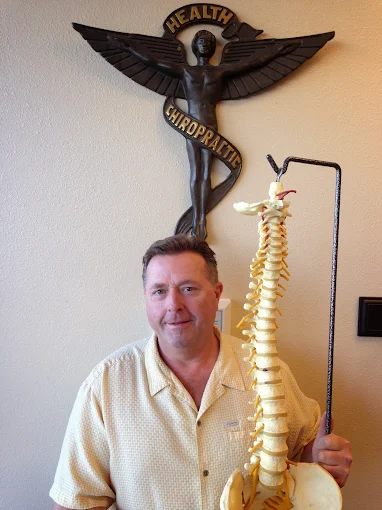
 Dr. Rick Bittner
Every November, the same thing happens. Bridger Bowl opens, half of Bozeman calls in "sick," and by the following Tuesday my waiting room is full of people who skied hard on legs and backs that spent the last six months sitting in a truck or at a desk. The first powder day is not the time to find out your hips don't extend and your core forgot its job.
The good news: you don't need a gym membership or a complicated program to change that. You need about six weeks, twenty minutes a few times a week, and a little honesty about where you're starting. Here's the plan I give my own patients.
Why skiing beats up your low back
Skiing asks your body to hold a loaded, flexed position for minutes at a time while absorbing thousands of small impacts. Three things tend to go wrong:
- Tight hip flexors. Months of sitting shortens the muscles across the front of your hips. When they can't extend, your pelvis tips forward and your lumbar spine arches to compensate. Every mogul and every chatter-filled groomer loads that arch.
- Sleepy glutes and core. The muscles that should stabilize your pelvis have been on vacation. Your low back muscles pick up the slack, fatigue early, and spasm by the third run after lunch.
- Stiff mid-back. A rounded, immobile thoracic spine forces your neck and low back to do all the rotating. That's how a routine fall turns into a week of not turning your head.
Your legs will get tired on the first day no matter what. The goal is to make sure your spine isn't the weakest link when they do.
Weeks 1–2: get moving again
Don't start with squats. Start by restoring range of motion so that when you do load your body, it loads in the right places.
- Half-kneeling hip flexor stretch. One knee down, squeeze the glute on that side, gently shift forward. 45 seconds each side, twice. You should feel it in the front of the hip, not the low back.
- Open books. Lying on your side with knees stacked, rotate your top arm open toward the floor behind you, following it with your eyes. Ten slow reps per side. This wakes up the mid-back.
- Glute bridges. On your back, knees bent, drive through your heels and squeeze at the top for two seconds. Two sets of fifteen. If you feel it in your hamstrings or low back, move your feet closer to your hips.
- Dead bugs. On your back, arms up, knees at ninety degrees. Lower the opposite arm and leg slowly while keeping your low back pressed flat. Two sets of eight per side.
Fifteen minutes, three or four days a week. If any of these hurt in a sharp or radiating way, stop and come see us before you go further.
A pre-season adjustment gets your pelvis and spine moving so the exercises actually work. Walk in any weekday.
Weeks 3–4: build the engine
Keep the mobility work as your warm-up, then add load. Nothing fancy.
- Goblet squats. Hold anything heavy at your chest (a kettlebell, a gallon of water, a small child who will tolerate it). Sit down between your heels, chest tall. Three sets of ten. This is the position you'll live in on the mountain.
- Reverse lunges. Step back, lower until your back knee nearly touches, drive up through the front heel. Three sets of eight per side. These teach your glutes to control your pelvis one leg at a time, which is what every turn demands.
- Side planks. Thirty seconds per side, three rounds. The lateral core muscles are what keep your hips level when you're on one edge.
- Wall sits. Ninety seconds, twice. Boring, effective, humbling.
Weeks 5–6: make it ski-specific
Now we add the two things the mountain demands that a gym rarely does: reactive strength and endurance under fatigue.
- Lateral bounds. Hop side to side, sticking each landing softly on one foot for a full second. Three sets of ten. Land quiet.
- Squat jumps to stick. Small jumps, soft landings, absorb through the hips, not the low back. Two sets of eight.
- The long wall sit. Work up to three minutes. Your quads will be the first thing to fail on day one; teach them to fail later.
- A real hike. Get on the M or Drinking Horse with a light pack and move continuously for an hour. Endurance is built by time on your feet, not by reps.
The week before opening day
Taper. Keep the mobility work daily, cut the strength work in half, and get your sleep. This is also the week to come in for an adjustment if anything feels off. A pelvis that's sitting level and a mid-back that rotates freely means the work you just did actually shows up on the hill.
Warm up in the lot for five minutes (leg swings, squats, torso twists). Ski the first two runs at seventy percent. Take a real lunch. Stop one run before you think you need to. And drink water on the drive home, not just at the bar.
If you're already hurting
If your back is bothering you before you've even bought your pass, don't try to train through it. Come in and let's find out what's going on. Most pre-season back pain we see is a pelvic alignment issue layered on top of tight hips, and it responds quickly to a specific adjustment plus the work above. A session on the PEMF mat or a deep tissue massage can speed things along.
Walk-ins are welcome every weekday at 2407 W Main. Get it handled now, and we'll see you in the spring for a tune-up instead of in December for a rescue.