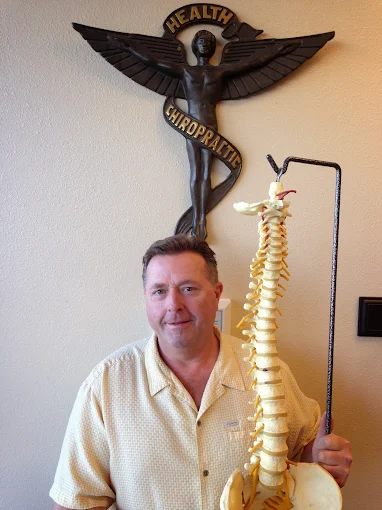
 Dr. Rick Bittner
One of the most common things I hear in an exam room is some version of: "I've had headaches for years. I've tried everything. Nobody can tell me why." Then I press gently on the joints at the very top of the neck, just under the skull, and the patient says, "That's it. That's exactly where it starts."
Those are cervicogenic headaches, which is a clinical way of saying headaches that originate in the neck. They're extremely common, frequently misdiagnosed as tension headaches or migraines, and they respond very well to the kind of care we provide. Here's how to tell if yours might be one of them.
What a cervicogenic headache feels like
No two people describe pain identically, but neck-driven headaches tend to share a fingerprint:
- They start at the base of the skull and wrap forward, often settling behind one eye or across the temple.
- They're usually one-sided, and they tend to stay on the same side rather than switching.
- Neck movement or sustained posture triggers them. A long drive, a day at the desk, sleeping wrong, or looking up for a while will bring one on.
- The neck feels stiff or sore at the same time, especially at the top, and turning your head fully one direction is harder than the other.
- Pressing on the upper neck reproduces the head pain. This is the tell.
Compare that with migraines, which are more often throbbing, associated with nausea or light sensitivity, and not reliably triggered by neck position. And with classic tension headaches, which tend to be band-like across both sides. There's overlap, and some people have more than one type, but the pattern above points pretty clearly at the neck.
Why the neck causes head pain
The nerves that supply the top three joints in your neck share a relay station in the brainstem with the nerve that supplies sensation to your face and head. When those upper neck joints are irritated, the brain can't always tell where the signal is coming from, and it reports pain in the head. This is called referred pain, and it's the same reason a heart attack can hurt in the left arm.
What irritates those joints? Usually one of three things:
- Sustained forward head posture from desks, phones, and driving, which loads the upper neck joints all day.
- An old injury such as whiplash, a fall, or a sports collision, sometimes years earlier, that left a joint restricted and the surrounding muscles guarding.
- Muscle tension in the suboccipitals, the small muscles at the base of the skull, and in the upper trapezius, which compress the joints and the nerves that pass through them.
Most people with neck-driven headaches have spent years treating their head. The head was never the problem.
A fifteen-minute evaluation can usually tell us whether your headaches are coming from your neck. Walk in any weekday.
What helps
Because the source is mechanical, the treatment is too. At Able Chiropractic, a headache visit typically looks like this:
- Find the source. We evaluate the upper cervical joints one at a time, checking motion and tenderness, and confirm whether pressing on them reproduces your headache. We also screen for the warning signs that would send you elsewhere first.
- Calm the tissue. Heat and pulse therapy, or a session on the PEMF mat, relax the suboccipital and upper trapezius muscles so the joints underneath can move.
- Restore motion. A specific, gentle adjustment to the restricted upper neck segments. Upper cervical adjustments are precise and controlled, not the dramatic twist people imagine.
- Take the load off. We look at the posture that's feeding the problem and give you two or three things to change, not twenty. Screen height, chin tucks, a different pillow. Small, sustainable fixes.
Many patients notice a difference after the first visit. For long-standing patterns, it typically takes a short series of visits to retrain the joints and muscles, and then we space things out. Massage therapy focused on the neck and upper back is a powerful complement, and both of our therapists have decades of experience with exactly this tension pattern.
Three things to try at home
- Chin tucks. Sitting tall, glide your chin straight back as if making a double chin. Hold five seconds. Ten reps, a few times a day. This unloads the upper neck joints.
- Check your pillow. Your neck should be neutral, not propped up or dropped back. Side sleepers usually need a thicker pillow than back sleepers.
- Raise your screens. Top of the monitor at eye level, phone up rather than head down. Your neck pays for every hour of looking down.
When a headache needs more than us
Most headaches are not dangerous, but some are. Seek urgent medical care for a sudden "worst headache of your life," a headache with fever and stiff neck, a headache after a significant head injury, a headache with confusion, weakness, vision loss, or trouble speaking, or a new headache pattern after age fifty. We screen for these on every visit, and we'll tell you plainly if what you're describing needs a physician first.
For everything else, if your headaches start in your neck, we'd like to take a look. Walk-ins are welcome every weekday at 2407 W Main St., no referral needed.